Xinhua
14 Feb 2026, 15:45 GMT+10
CHENGDU, Feb. 14 (Xinhua) -- Before his village wakes each morning, Lhogya has already checked on his horses.
At nearly 4,000 meters above sea level in Dege County of the Garze Tibetan Autonomous Prefecture in the western Sichuan Province, winter days begin cold and dry. One recent morning, Lhogya entered the stable and paused by each of his three horses: one raised from a family mare, one used for herding, and a racehorse he purchased with money he had set aside.
"A horse is a herder's legs," he said. "It is your closest companion."
For much of the 20th century, that saying was a literal one. On the plateau, distance used to be measured in hooves, and across the high-altitude pastures, horses represented transport, labor and connection. They carried herders across seasonal grazing grounds and linked isolated settlements separated by mountain passes. Riding was not a sport, but something more like infrastructure.
What had once defined mobility was gradually overtaken as motorcycles, tractors and trucks began appearing on the grasslands in the 1980s and 1990s. Roads extended into previously remote counties. A tunnel cut through mountains that used to divide the county. And a regional airport opened, named after King Gesar, a legendary hero of Tibetan epics.
In recent years, new highways have reached the grasslands, with even new energy vehicles now seen in areas where transport had long depended on horses.
But the use of horses has not vanished -- it has simply lost its monopoly.
For Chodru Tsering, 68, this transition has spanned a lifetime. He grew up in a household that could not afford a horse, and at 16, he enlisted in the army and was assigned to care for military mounts. "My dreams came true overnight," he told Xinhua.
In 1976, after a 7.8-magnitude earthquake devastated Tangshan City in northern China, he helped load horses onto trucks bound for relief work. The animals he had taken care of were sent to transport supplies in conditions where vehicles struggled.
After completing his service, Chodru Tsering returned home as economic reforms reached the plateau. Motorcycles and cars were becoming more common, gradually replacing horses as transport for many families.
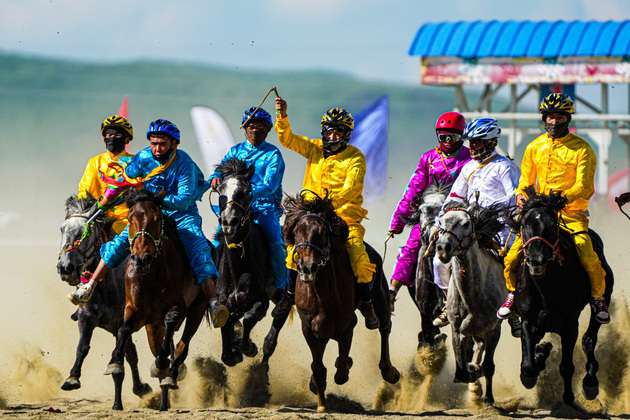
Yet horses retained their cultural value, and were economically adaptable. Each summer, racing festivals draw riders from across Dege County. More than 10 competitions are held annually, with prize money ranging from thousands to tens of thousands of yuan. These events combine sport, tradition, and a growing commercial edge.
Chodru Tsering began breeding selectively, studying bloodlines and adjusting training methods. He now keeps five horses, earning roughly 200,000 yuan (about 28,819 U.S. dollars) a year between prize winnings and the sale of foals.
Prize money and breeding contracts now determine the value of a horse, rather than the ability to endure mountain crossings. In Hongyuan County in the Tibetan and Qiang Autonomous Prefecture of Aba, a young entrepreneur has built a different model around the same animal. Former boxer Rinqen Wangyal returned home in 2019 after studying equestrian training for four years in Beijing. Having accumulated 200,000 yuan in prize money, he opened an equestrian club on the grasslands.
His stable houses 43 horses, most of which are Hequ horses, a breed well-suited to high-altitude conditions. Rinqen Wangyal has abandoned the traditional practice of whipping and instead relies on methods he learned in Beijing, using body language to communicate with horses in what he described as "a calmer training environment."
Visitors -- primarily urban Chinese travelers, as well as a significant number of foreign tourists -- stay in tents, learn basic riding techniques and spend time on open pastures. In 2025, the club reported profits of about 600,000 yuan.
Improved infrastructure has reshaped his visitor flows. An extended expressway opened late last year, connecting Hongyuan more directly with surrounding regions and ending its long-standing lack of highway access. Rinqen Wangyal now plans to expand into winter riding programs, predicting steadier year-round traffic.
Across western Sichuan, mobility now depends largely on engines. Motorcycles and cars have replaced horses for much of the daily travel across grazing land. New roads and a regional airport have shortened travel times and improved connections between once-remote counties and outside markets.
However, horses remain ubiquitous in the region, seen on racing circuits, in breeding operations and across tourism ventures that market riding as an experience rather than a necessity.
Last year, Lhogya entered a village race that saw his horse break ahead in the final stretch to finish first. But Lhogya prefers riding on open grassland: "On the racecourse, you compete in skill. On the grassland, that's where the horse -- and we -- belong."
On the plateau today, horses may be less important to daily labor, no longer indispensable to survival, and no longer the main form of transport, but it is clear that they still matter.
Get a daily dose of Peking Press news through our daily email, its complimentary and keeps you fully up to date with world and business news as well.
Publish news of your business, community or sports group, personnel appointments, major event and more by submitting a news release to Peking Press.
More InformationHONG KONG: A surge in initial public offerings in Hong Kong is exposing staffing strains at Chinese investment banks, as regulators...
NEW YORK, New York - U.S. stock markets edged in and out of positive territory Friday, with little commitment in either direction....
LONDON, U.K.: French drugmaker Sanofi has abruptly removed Chief Executive Paul Hudson, signaling mounting investor pressure over sluggish...
HONG KONG: Diplomatic tensions between China and countries such as Japan and the United States have flared repeatedly in recent years....
NEW YORK CITY, New York: The recent sharp selloff in U.S. software stocks, fueled by concerns that advances in artificial intelligence...
NEW YORK, New York - U.S. stocks fell sharply on Thursday, ahead of Friday's inflation report which is not expected to weigh on markets....
HONG KONG: A surge in initial public offerings in Hong Kong is exposing staffing strains at Chinese investment banks, as regulators...
HONG KONG: Diplomatic tensions between China and countries such as Japan and the United States have flared repeatedly in recent years....
HONG KONG: Jimmy Lai, the 78-year-old pro-democracy former Hong Kong media tycoon and a fierce critic of Beijing, received a 20-year...
BEIJING, Feb. 14 (Xinhua) -- Chinese President Xi Jinping on Saturday extended Spring Festival greetings at a reception in Beijing...
CHENGDU, Feb. 14 (Xinhua) -- Before his village wakes each morning, Lhogya has already checked on his horses. At nearly 4,000 meters...
Zindi Village, located in northern Zimbabwe's Mashonaland Central Province, has witnessed a rapid transformation in agricultural development...