Xinhua
16 Mar 2026, 17:46 GMT+10
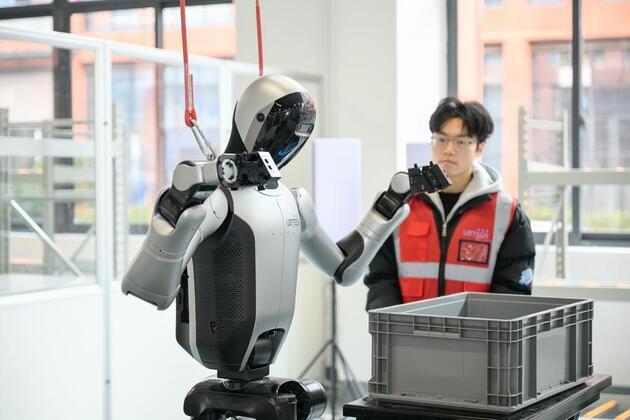
CHENGDU, March 16 (Xinhua) -- The afternoon sun streamed into a huge hall of the Sichuan Humanoid Robot Multimodal Data Collection and Testing Center in Zigong City in southwest China's Sichuan Province. Row after row of Walker S2 humanoid robots stood silent, awaiting their final performance tests.
In this vast space, which is now in the final stages of commissioning, the whir of servo motors blended with the soft clicks of sensors.
Inside the "express sorting scenario," Ouyang Yuanbin, a robot trainer in his early 20s, slipped on a VR headset. His movements were mirrored in real-time by a Walker S2 a few meters away. On a computer screen, the robot's perspective showed its metallic hand reaching for a parcel. It gripped the package firmly, then coordinated with its other hand to place it precisely on another table.
What looked simple was a symphony of data. Pressure sensors at the fingertips recorded micro-changes in friction. Vision sensors captured the angle and posture of the hand relative to the package handle. Every shift in the robot's center of gravity was logged by joint torque sensors.
The system was not just moving a box. It was mining gold-high-quality, real-world data that serves as the "food" for artificial intelligence.
"The goal is to combine human teleoperation with autonomous collection," Ouyang explained, never taking his eyes off the screen. By the end of this single shift, the robot would have generated thousands of data trajectories for the "pick-and-place" task.
This facility covering 6,000 square meters, which officially opened on Jan. 8, is expected to reach full production by March. At full capacity, it will generate 15,000 data entries daily and up to 3 million high-quality entries annually. It represents a critical piece of China's strategy to move from "robot manufacturing" to "robot intelligence."
The urgency behind this effort reflects a fundamental truth about the industry. Last year was considered China's first year of the mass production of humanoid robots, with over 140 domestic manufacturers releasing more than 330 different models. Yet behind the optimism lies a hard reality: data scarcity remains the critical bottleneck to mass commercialization.
"Even if the 'baby' is born smart, without real-world datasets to feed it, it cannot grow," said Wang Feili, an industrial sector analyst with UBS Securities China, during a media sharing session in January.
Unlike autonomous driving, which relies on billions of miles of road-test data, operational data for humanoid robots in complex environments is extremely scarce, Wang added.
Ye Yangsheng, co-founder of Shanghai-based SEER Robotics, already noted at the 2025 Zhangjiang Embodied AI Developer Conference in May that humanoid robots require massive amounts of data for training, but collecting data in real-world environments is extremely costly.
Training a robot to sort a single battery requires tens of thousands of grasping actions, accounting for variables such as lighting and material properties. A single data collection session can cost over 1,000 yuan, said Ye.
Perhaps the most stubborn bottleneck isn't just the quantity of data, but the quality of perception.
Speaking at the Humanoid Robots and Embodied Intelligence Standardization (HEIS) annual meeting in Beijing on Feb. 28, Peng Zhihui, co-founder of AGIBOT, highlighted a critical gap: "When we analyzed industrial scenarios, we found that nearly 80 percent of tasks where humans excel, but traditional automation struggles are strongly related to tactile sensing. The bottleneck results from the absence of standardized technological pathways for tactile sensors."
In response to these challenges, China has unveiled its first national standard system for humanoid robotics. The framework is China's first comprehensive, top-level design covering the entire industrial chain and full lifecycle of humanoid robotics and embodied intelligence, aiming to unify technical specifications, evaluation criteria, and interface protocols across the fragmented but fast-evolving industry.
Meanwhile, robot training and data collection facilities have mushroomed across the country. Multiple cities including Beijing, Zigong in Sichuan, Liuzhou in Guangxi, Jiujiang in Jiangxi, Wuxi in Jiangsu, Wuhan in Hubei, Shaoxing in Zhejiang, and Zhengzhou in Henan have all established embodied intelligence data collection centers. In addition, large-scale, specialized training grounds have been built in cities such as Shanghai, Tianjin, Guangzhou, and Qingdao.
The Zigong facility integrates advanced equipment, including joint torque sensors, multimodal vision systems (RGB-D cameras), and LiDAR. It can capture data with high precision, including vision, touch, and motion trajectories, during the robot's "motion control," "environmental interaction," and "task execution" processes.
By simulating real industrial scenarios, the center trains robots to complete basic actions such as "grasping, holding, taking and placing," accumulating massive amounts of high-quality data. This data provides solid support for algorithm optimization, intelligent upgrades, and R&D iteration of robots, and allows new algorithms and models to be validated in real-world environments.
As of Feb. 24 this year, Sichuan Province had registered 1,138 robot-related enterprises. Together with the operation of the data collection center, it has laid a solid foundation for Sichuan to achieve more breakthroughs in the "AI plus" field, according to the provincial science and technology department.
As night fell over the Zigong facility, the lights inside the testing center cast long shadows. One Walker S2, standing alone under a beam of light, looked almost like a visitor from another world. But it is not from another world. It is from here -- trained, tested, and soon to be deployed in factories or warehouses somewhere in China.
Get a daily dose of Peking Press news through our daily email, its complimentary and keeps you fully up to date with world and business news as well.
Publish news of your business, community or sports group, personnel appointments, major event and more by submitting a news release to Peking Press.
More InformationSYDNEY/LONDON: The war involving Iran is disrupting travel worldwide, forcing airlines to reroute flights, raising ticket prices, and...
WASHINGTON, D.C.: Smaller portions are emerging as one of the biggest trends in the restaurant industry as diners look to spend less...
BEIJING, China: Apple said it will reduce the commission fees it charges on its App Store in mainland China, a move expected to save...
LONDON, U.K.: Chinese electric vehicle maker BYD said on March 13 that it will launch a new premium EV in Europe next month capable...
WASHINGTON, D.C.: About one-third of Americans cut spending on food, utilities or other basic expenses in 2025 in order to pay for...
WASHINGTON, D.C.: The rising cost of new vehicles in the United States is increasingly pushing many buyers out of the market, as automakers...
BEIJING, China: Apple said it will reduce the commission fees it charges on its App Store in mainland China, a move expected to save...
LONDON, U.K.: Chinese electric vehicle maker BYD said on March 13 that it will launch a new premium EV in Europe next month capable...
CHENGDU, March 16 (Xinhua) -- The afternoon sun streamed into a huge hall of the Sichuan Humanoid Robot Multimodal Data Collection...
NANCHANG, March 16 (Xinhua) -- The eggshell porcelain is renowned for its papery and translucent porcelain body. Its production involves...
Beijing [China], March 16 (ANI): China on Monday reiterated the importance of maintaining stability and security in the Strait of Hormuz,...
Bengaluru (Karnataka) [India], March 16 (ANI): Some of the world's finest runners are set to descend upon Bengaluru for the 18th edition...