Xinhua
18 Apr 2026, 14:15 GMT+10
Ultimately, China-EU economic relations have never been a zero-sum game. They are a partnership with deeply intertwined interests. China's new energy equipment and electromechanical products are precisely what Europe needs for its green transition and industrial upgrade. Conversely, Europe's high-end manufacturing and precision instruments serve as catalysts for China's ascent in the industrial value chain.
by Shao Xia
Recent visits by multiple European leaders to China signal a warming trend in relations between China and many European nations. However, amid this thaw, some voices in Europe continue to push the narrative of a "China-EU trade imbalance."
They cite the nearly 300-billion-U.S. dollar surplus China held over the European Union (EU) last year, arguing that the gap is evidence of "overcapacity," "dumping" and "trade diversion." This rhetoric has fueled 15 trade remedy investigations against China in the past year, with some official think tanks even recommending blanket 30 percent tariffs.
Economic and trade cooperation has long been the cornerstone of China-EU relations. Then comes the question: Is Europe truly at a disadvantage? A closer look reveals a more complex and mutually beneficial reality.
First, the China-EU trade landscape is not static. It evolves dynamically with industrial development and shifts in comparative advantage. For the two decades leading up to 1996, the EU consistently maintained a trade surplus with China, exporting high-end industrial equipment, automobiles, precision instruments and chemical materials. Back then, this was viewed as a natural outcome of the global division of labor -- countries playing to their strengths, each meeting the other's needs.
The current situation reflects this same principle. On one hand, Europe faces internal constraints on industrial growth, including navigating 27 different regulatory standards and complex approval processes that hamper market responsiveness. The Eurozone's share in the global high-tech market has declined, and competitiveness in traditional strengths has gradually narrowed. China, on the other hand, has been steadily advancing up the industrial value chain, gaining new competitive edges in equipment manufacturing and green industries. This competitive dynamic is not a zero-sum game but a virtuous cycle of mutual growth under globalization.
External challenges and internal policy shifts in Europe have also contributed to the current trade structure. For instance, following the escalation of the Russia-Ukraine conflict, the EU's decision to sharply reduce its reliance on Russian natural gas led to a dramatic energy supply restructuring.
However, the energy transition lagged, causing industrial electricity prices to soar. Currently, production costs for a significant portion of European manufacturing firms -- especially in energy-intensive sectors -- are often estimated to be around 15 to 30 percent higher than those in China, eroding their competitiveness. Furthermore, Europe's own export controls on high-tech products restrict, to some extent, its export potential to China. Loosening restrictions on such high-end technology exports could help alleviate the perceived trade imbalance.
Moreover, measuring the China-EU economic relationship solely by goods trade deficits is neither comprehensive nor objective. A significant number of European companies operate locally in China, deeply integrated into the Chinese market. While they cater to Chinese consumer demand, part of their output is re-exported to Europe.
Take a practical example: If Volkswagen produces a new energy vehicle in China and sells it to a customer in Shanghai, this transaction is not counted in China-EU trade statistics because both production and consumption occur within China. Yet, Volkswagen's profits from that sale are repatriated to Germany. If that same vehicle is shipped back to Hamburg for sale, it appears in customs data as a Chinese export to Germany, contributing to Germany's "trade deficit" with China. However, the bulk of the profit -- including brand value, technology licensing and capital dividends -- still returns to Volkswagen's European headquarters.
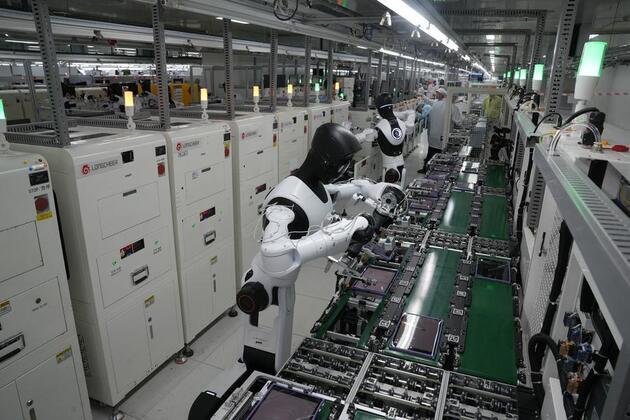
Additionally, a large share of China-EU trade consists of intermediate goods. Chinese industrial equipment is often more cost-competitive than comparable European products. This significantly reduces production costs for European companies and enhances the competitiveness of their final products -- a clear win-win.
From a trade-in-service perspective, Europe holds an absolute advantage. In recent years, the EU has recorded a sizable services trade surplus with China. Intellectual property royalties alone generate significant annual income for European firms. These benefits are less visible in goods trade data but form an important component of Europe's economic gains in its business relations with China.
Ultimately, China-EU economic relations have never been a zero-sum game. They are a partnership with deeply intertwined interests. China's new energy equipment and electromechanical products are precisely what Europe needs for its green transition and industrial upgrade. Conversely, Europe's high-end manufacturing and precision instruments serve as catalysts for China's ascent in the industrial value chain.
The so-called "trade imbalance" is less a problem of excessive cooperation than a reflection that the cooperative pie is not yet large enough. The deficit figures are merely the tip of the iceberg. Beneath the surface lie vast opportunities in services trade, technology collaboration and mutual investment -- a blue ocean waiting to be explored.
Regardless of shifting global winds, China will continue its steady march toward higher-end industries -- an unstoppable trend. For Europe, rather than retreating behind self-imposed barriers, engaging proactively in China's market is the wiser path. Embracing China means embracing opportunities. That is not just a choice -- it is a strategic imperative for mutual prosperity.
Editor's note: Shao Xia is a commentator on international affairs, writing regularly for Xinhua News Agency, the Global Times, China Daily, CGTN, etc.
The views expressed in this article are those of the author and do not necessarily reflect the positions of Xinhua.
Get a daily dose of Peking Press news through our daily email, its complimentary and keeps you fully up to date with world and business news as well.
Publish news of your business, community or sports group, personnel appointments, major event and more by submitting a news release to Peking Press.
More InformationNEW YORK, New York - U.S. stocks shot higher on Friday, with major indices notching up record highs intra-day and at the close. Earlier...
WASHINGTON, D.C.: A Starlink outage that disrupted U.S. Navy drone tests off the California coast has highlighted growing concerns...
LONDON, U.K.: A surge in high-paying banking jobs across Europe has done little to close the gender gap at the top of the financial...
HOUSTON, Texas: A sharp disruption to Middle East oil flows has pushed the United States to the brink of becoming a net crude exporter...
NEW YORK, New York - Major U.S. stock indexes finished Thursday's trading session in positive territory, driven by technology sector...
NEW YORK CITY, New York: Two of the largest names in the U.S. pizza market are moving closer to potential sales, as mounting cost pressures...
WASHINGTON, D.C.: On April 15, U.S. President Donald Trump said that China had agreed not to send weapons to Iran, even though there...
WASHINGTON, D.C.: The global economy is entering a period of heightened risk as the war in Iran disrupts energy markets, with the International...
by Yi Ling BEIJING, April 18 (Xinhua) -- No celebrity. No influencer. No scripted drama. The unlikely star of a recent marathon...
Ultimately, China-EU economic relations have never been a zero-sum game. They are a partnership with deeply intertwined interests....
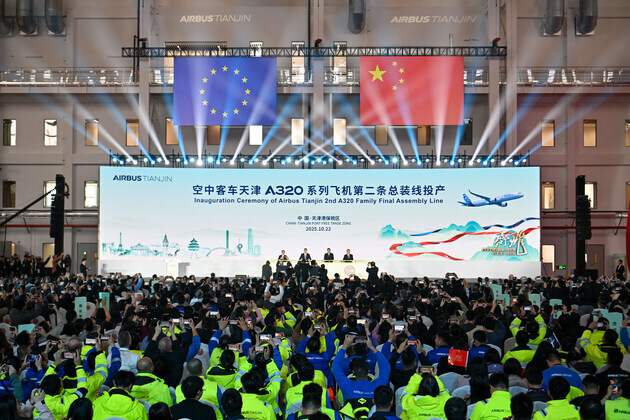
(260418) -- XI'AN, April 18, 2026 (Xinhua) -- This photo shows the inauguration ceremony of Airbus' second Final Assembly Line (FAL)...
BEIJING, 18th April, 2026 (WAM) -- A delegation from the General Women's Union (GWU) held a high-level strategic meeting with the Central...