Xinhua
28 Apr 2026, 09:45 GMT+10
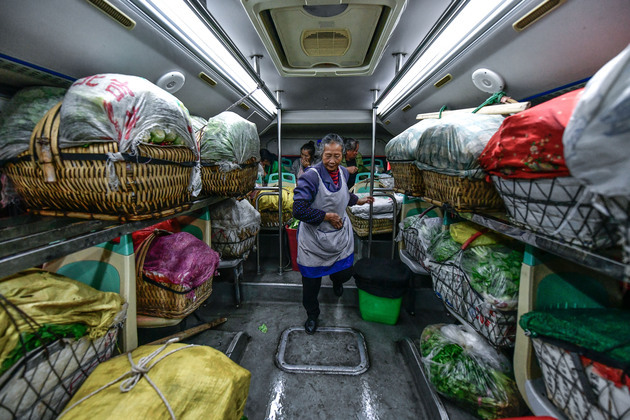
GUIYANG, April 28 (Xinhua) -- At 5:30 a.m., the mountain village of Guding already began to hum, as dozens of farmers gathered together for a pre-dawn bus specially designed to accommodate their baskets, often muddy, bulky and filled with freshly picked vegetables carrying the earthy scent of the soil.
They were waiting for the first departure of a customized No.252 bus, which would take them to a vegetable market in Guiyang, the capital of southwest China's Guizhou Province.
By meeting farmers at their doorstep, such "muddy basket" bus services are more than transport.
In Guizhou, a rugged province once locked in grinding poverty, these farmer-dedicated buses run along mountainous roads and towering bridges, transforming not just villagers' commute, but their connection to the urban economy.
U.S. influencer Jackson Hinkle documented his travel alongside farmers on the bus in a vlog. "It's a beautiful program, and it has provided a lot of opportunities for the farmers here in Guizhou," he said.
When the first bus arrived, normally around 6:10 a.m., farmers carrying baskets on their backs got on the bus one after another. After hoisting her baskets loaded with red rapeseed shoots, wild garlic and scallions onto the vehicle, Zuo Fuxiu leaned against the handrail, and let out a long breath.
Zuo's back is bent from decades of carrying her vegetables to market, but her spirit is lifted. "By taking a bus, I can earn more by selling vegetables and save a decent amount of money by the end of the year," she said.
At 76, Zuo has been selling vegetables in Guiyang for over 30 years. Traveling to the city used to be the hardest part. She would leave home at 3 or 4 a.m., walk for more than an hour, and then hitch a ride into town.
Buses were not an option back then because they started too late for farmers to reach the early market. "And our baskets are often muddy and bulky -- we didn't want to inconvenience other passengers," explained a farmer standing beside Zuo.
This inconvenience prompted the local bus company to upgrade the route and launch a "farmer-friendly" bus service in 2024. To better meet farmers' needs, such buses, installed with extra luggage racks for holding the vegetable baskets, have advanced departure time and provided discounted fares: 2 yuan (about 29 U.S. cents) per passenger, 3 yuan for one basket and 5 yuan for two, with a one-way ticket capped at 7 yuan.
Today, Zuo paid just 7 yuan to board the bus, down from dozens of yuan on a private ride, and the journey has been shortened from over an hour to about 40 minutes.
Mei Kaicui, a 75-year-old vegetable grower, is another regular passenger on the bus.
Living in Dingba Village, Mei has been selling vegetables in Guiyang for more than a decade. She recalled having to leave home at 4 a.m., carry over 50 kilograms of produce on her back, and walk about 2 miles to catch a bus.
The upgraded No. 252 bus brought the bus station closer to her home. Mei now travels to the city every two or three days -- and even more frequently in spring, a harvest season for her rapeseed shoots.
"My children told me to stop traveling to the city to sell the produce, but I am just not the stay-at-home type," she said. "With the extra income from selling vegetables, I can give my grandchildren more lucky money during the Chinese New Year."
At around 6:50 a.m., the bus arrived at its terminal near the Hongbianmen farmers' market. There, Zuo spread a plastic sheet on which she neatly placed her vegetables for sale. Their vegetables are popular among local residents for their freshness and lower prices.
In recent months, this humble bus service has gone viral on social media, winning over influencers and netizens with its genuine care for small farmers.
However, the state-owned bus company that operates the line takes the services as "just part of its routine work", saying that "nobody considers it anything out of the ordinary."
"Responding to people's needs is exactly what public transport is meant to do. Wherever the people need service, that's where our routes will go," said an executive of the company.
Statistics show that Guiyang has so far launched 41 such bus lines tailored to needs such as agricultural transport, daily commuting, market trips, and seasonal rural tourism. They have recorded 300,000 trips by farmers and transported more than 1,400 tonnes of agricultural products.
With such services becoming an engine for rural revitalization, more similar services have been launched across the country. Southwest China's Chongqing Municipality has introduced a "back-basket special metro line" to help vegetable and fruit growers reach the city market.
In Xingan County, east China's Jiangxi Province, "one-yuan vegetable farmers' buses" have been operating for over three years to benefit residents from 134 villages.
After accomplishing the historic task of eliminating absolute poverty, China has continued to promote coordinated urban-rural development. This year's government work report calls for strengthening inclusive, fundamental and safety-net public services to address people's most pressing concerns, facilitate social mobility, and improve quality of life.
In Guiyang, more pro-farmer initiatives are being rolled out. At the terminal stop of the No. 252 line, a new waiting hall with free hot water is already operational to shelter homecoming vegetable growers from inclement weather.
"We wish such a place would extend the city's warm embrace to its own hardworking people," said an official with the bus line operator.
Get a daily dose of Peking Press news through our daily email, its complimentary and keeps you fully up to date with world and business news as well.
Publish news of your business, community or sports group, personnel appointments, major event and more by submitting a news release to Peking Press.
More InformationNEW YORK, New York - U.S. stock markets closed with a divided performance on Monday, as technology shares lifted the Nasdaq Composite...
WASHINGTON, D.C.: U.S. consumer confidence fell to its lowest level on record in April, as rising energy costs linked to the Iran war...
NEW YORK CITY, New York: Goldman Sachs has agreed to settle a shareholder lawsuit accusing it of misleading investors over its role...
BEIJING, China: China has sharply criticized the European Union's decision to include Chinese companies in its latest sanctions against...
LOS ANGELES, California: Tesla's long-promised robotaxi expansion is progressing more slowly than expected, with CEO Elon Musk adopting...
SAN FRANCISCO, California: Intel shares surged sharply after the chipmaker reported unexpectedly strong demand for its processors,...
BEIJING, China: China has sharply criticized the European Union's decision to include Chinese companies in its latest sanctions against...
KATHMANDU, Nepal: A crevasse strewn with chunks of ice, including one towering block, has stranded hundreds of mountaineers at the...
GUIYANG, April 28 (Xinhua) -- At 5:30 a.m., the mountain village of Guding already began to hum, as dozens of farmers gathered together...
BEIJING, April 28 (Xinhua) -- China's goji berry history dates back thousands of years. In ancient herbal medicine, its functions included...
(260428) -- BEIJING, April 28, 2026 (Xinhua) -- This photo taken on April 27, 2026 shows water lilies at the University of South China...
Washington DC [US], April 28 (ANI): With the USA engulfed in a war of its own making against Iran, there is valid concern that the...