Xinhua
05 May 2026, 07:46 GMT+10
China's Su Super League has become a holiday hit, setting new attendance records and blending local culture with football fever. Supported by local policies and incentives, the league has boosted tourism and spending, embodying China's booming experience economy.
by sportswriter He Leijing
NANJING, May 5 (Xinhua) -- For Changzhou resident Yu Jie, this year's Labor Day holiday came close to perfection. In a deep-dive trip to Nanjing, he secured coveted tickets to watch his hometown side in the Su Super League, feeling the carnival-like energy of grassroots football.
Despite a steady drizzle and a penalty shootout loss for Changzhou, Yu said the result hardly mattered. "The atmosphere was incredible," he recalled. "My wife and I aren't really football followers, but our eight-year-old son is an avid fan."
For days before the match, his son buzzed with anticipation. "He's always wanted to see a Su Super League game and cheer for our home team," Yu said. "When we got the tickets, he couldn't stop talking about it."
Families like Yu's are part of a broader trend reshaping holiday consumption in China. Over the five-day Labor Day break, attending a football match has become an immersive experience, one that turns casual spectators into passionate supporters, especially in the country's rapidly growing "city leagues," where amateur teams represent their hometowns in spirited inter-city rivalries.
"There's a real sense of belonging," Yu said. "I don't even fully understand the offside rule, but I still found myself shouting and cheering." Across Nanjing, he added, the football fever was palpable, with match tickets unlocking discounts on hotels and tourist attractions, weaving sport into the fabric of urban leisure.
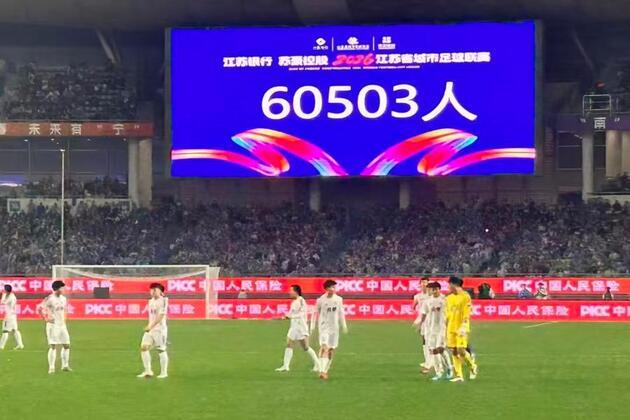
The May 2 clash in Nanjing drew a crowd of 60,503, setting a new attendance record for the league's second season. What began as a grassroots competition last year evolved into a cultural phenomenon. Featuring 13 cities across Jiangsu, a province of more than 80 million people, the league attracted over 2.43 million spectators last year, averaging nearly 28,600 per match.
Momentum has only intensified this year. On May 2 alone, four matches pulled in more than 150,000 fans, rivaling attendance figures in some professional leagues. In many cities, ticket applications exceed 100,000, constrained only by stadium capacity.
Part of the appeal lies in its playful embrace of local identity. Teams are often nicknamed after regional specialties - Wuxi represented by its famed honey peaches, Nanjing by its iconic salted duck - infusing matches with humor and cultural resonance.
"It's just so much fun," said Wang Lin, a visitor from Wuxi who attended the Nanjing match. "Even people who weren't football fans are getting involved. The slogans and symbols connect deeply with each city's culture."
Wang said the experience marked a departure from traditional holiday routines. "Travel used to mean visiting scenic spots or shopping districts," she said. "Now you can watch a match, check in at stadiums, buy themed merchandise, and even play the role of a fan cheering for your city. It's a completely new experience."
Local governments have been quick to capitalize on the trend. Host cities across Jiangsu have rolled out incentives for visiting fans, including discounted or free entry to tourist sites, expedited airport security lanes, complimentary transport, and even free accommodation in some cases.
This year, the league also introduced a mascot inspired by the Yangtze finless porpoise, whose endearing image has spawned more than 20 types of merchandise, quickly becoming a fan favorite.
Data from travel service platforms show that during the holiday, chartered tour bookings in Jiangsu rose 45 percent year-on-year, while hotel reservations surged by more than 50 percent, underscoring how sporting events are driving incremental tourism spending.
To extend the experience beyond stadium walls, Jiangsu authorities have expanded to 638 "second-screen venues" across the province in 2026, allowing those without tickets to soak up the matchday atmosphere. These venues combine live screenings with food fairs, brand showcases, and tech exhibitions, further boosting consumption.
The surge aligns with broader policy direction. A government plan released this year calls for cultivating new growth drivers in service consumption, encouraging the development of immersive, emotionally engaging consumer scenarios built on emerging business models.
According to a development report on China's experience economy released last year, the country's experience economy market is expected to exceed 22 trillion yuan (3.2 trillion U.S. dollars) by 2026.
Experts say the Su Super League exemplifies this shift. "Unlike traditional consumption, the experience economy emphasizes sensory enjoyment, emotional value and depth of participation," said Wei Xiang, a professor at the Chinese Academy of Social Sciences.
"Players are both producers and consumers of the event, while spectators are not only consumers but also co-creators of the experience," Wei said. "This integration creates a long-tail effect, sustaining demand and generating new momentum for consumption."
Wei added that the league is reshaping how Chinese people think about leisure. "Vacations used to mean spending days at the beach or in the mountains," Wei said. "But the Su Super League has, in a way, invented a new kind of holiday, one that fits neatly into weekends and public breaks."
For Yu, the appeal goes beyond economics. "Watching the match live was not just exciting, it was therapeutic," he said. "It lets you release stress and fully immerse yourself in the moment."
As for his son, the experience has already left a lasting mark. "After the match, he was so satisfied," Yu said. "Now he wants to sign up for football training this summer. Maybe that's the real magic of the game."
Get a daily dose of Peking Press news through our daily email, its complimentary and keeps you fully up to date with world and business news as well.
Publish news of your business, community or sports group, personnel appointments, major event and more by submitting a news release to Peking Press.
More InformationNEW YORK, New York - World stock markets closed sharply lower on Monday after a sudden escalation of tensions in the Middle East drove...
OMAHA, Nebraska: Berkshire Hathaway's annual shareholder meeting entered a new era on Saturday as CEO Greg Abel led the event for the...
WASHINGTON, D.C.: Major U.S. airlines and government officials moved quickly to assist stranded passengers after Spirit Airlines ceased...
HOUSTON, Texas: The global natural gas market has split sharply in recent weeks, with Europe and Asia scrambling for supply while the...
WASHINGTON, D.C.: Bankrupt discount carrier Spirit Airlines is preparing to cease operations after failing to reach an agreement with...
CUPERTINO, California: Apple reported better-than-expected quarterly earnings on May 1, driven by strong iPhone sales, as investors...
DUBLIN, Ireland: The Supreme Court has ruled that TikTok can keep operating in Ireland while the country's data regulator continues...
NEW YORK CITY, New York: U.S. stocks hit new record highs this week, even as oil markets saw sharp swings driven by ongoing tensions...
HELSINKI, Finland: Finnish elevator maker Kone has agreed to acquire Germany's TK Elevator in a US$34 billion deal that would reshape...
China's Su Super League has become a holiday hit, setting new attendance records and blending local culture with football fever. Supported...
LONDON, May 4 (Xinhua) -- Wu Yize became the second Chinese to win World Snooker Championship following Zhao Xintong's triumph last...
(260505) -- NANJING, May 5, 2026 (Xinhua) -- French national Bastien Ratat speaks at a handover ceremony featuring scanned copies of...