Xinhua
21 May 2026, 17:47 GMT+10
BEIJING, May 21 (Xinhua) -- For Deng Hongyan, a Beijing-based landscape architect who uses a wheelchair, a 10-centimeter step was once enough to turn a simple trip for coffee into an ordeal.
Like many busy professionals, she simply wanted to grab her daily coffee. But a single step at the entrance of a cafe in her office park became a major obstacle. She often had to ask strangers to go inside and buy the coffee for her, something that always left her feeling embarrassed.
When the step was finally replaced by a gentle ramp in 2024, Deng could roll into the cafe and order her coffee all by herself. "As the accessible facilities in China improve, I don't need to bother others anymore," she said.
Deng is not alone in noticing the changes. Lu Xin, an 82-year-old resident of a hutong in downtown Beijing, said she was delighted to find that getting around has become easier, rather than harder, as she has grown older, thanks to the steady transformation of her neighborhood into an elderly-friendly community.
"A ramp has been built at the entrance of the supermarket near my home. And public toilets in the alley are not only plentiful but also equipped with handrails," Lu said.
Behind these small, everyday improvements lies a massive demand for barrier-free facilities in China. So far, the number of Chinese people with disabilities has exceeded 85 million. More importantly, the country faces growing challenges from its rapidly aging population. By the end of 2025, its population aged 60 and above had surpassed 320 million, accounting for over one-fifth of the total population.
To meet the growing demand, China enacted a law on building a barrier-free living environment in 2023, giving its accessibility push a legal backbone.
"After the law was passed, the biggest change was in people's attitudes," Deng said. "Whether it's the renovations in the office park, the public works around the city, or even strangers offering a helping hand, all of it happens more often than before."
Indeed, the law marks a conceptual shift at the legislative level in China, from "special treatment" to "universal benefit." While underscoring that barrier-free facilities should be developed to enable people with disabilities and the elderly to participate fully, equally and conveniently in social life, it also stipulates that other groups with barrier-free needs, including pregnant women, children, and the sick or injured, may enjoy the same facilities.
"Accessibility is not just about removing barriers for people with disabilities. It's about creating a world where all of us, no matter our stage in life, can move around and engage with others freely," said Pan Haixiao, a professor at the College of Architecture and Urban Planning, Tongji University.
More than two years after the law took effect, change is visible across China. At intersections in Shenzhen's Futian district, AI detects the gait of vulnerable pedestrians and automatically extends crossing times.
In Wuhan, capital of central China's Hubei Province, curb ramps and tactile paving have been installed at every pedestrian crossing, while 67 elevators have been added to existing footbridges.
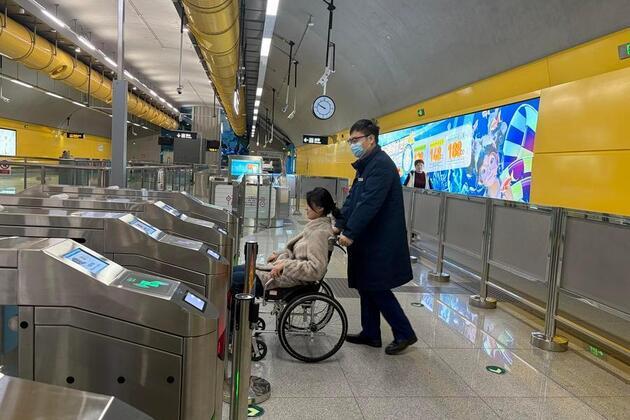
In Beijing, over half of all public buses, and more than 80 percent in urban areas, now feature low-floor designs, ramps and wheelchair securement systems. Passengers can check the real-time availability of these buses and receive voice notifications via a mobile app.
Notably, the 2023 legislation also allows procuratorial authorities to file public-interest lawsuits to enforce accessibility standards, thereby strengthening legal oversight. Organizations representing people with disabilities have become more closely involved in such litigation, assisting with case referrals, professional assessments, and follow-up evaluations.
In 2025, the China Disabled Persons' Federation, the Supreme People's Procuratorate and the Ministry of Civil Affairs released a series of typical cases to raise public awareness of the importance of accessibility.
Zhang Yi, a disabled architect and vlogger measuring and documenting accessible facilities across Beijing, files reports to local procuratorates on locations without proper barrier-free facilities. According to him, the barrier-free legislation has made a real difference.
"Having the law is like having teeth; now it can really bite," Zhang said. "Unlike before, when regulations were sometimes ignored, projects that fall short simply don't get approved now. The legislation has pushed accessibility from just having facilities to having facilities that actually work."
Beyond legislation, China has also strengthened its policy framework to steadily improve a barrier-free environment. Efforts will be intensified to carry out age-friendly and barrier-free retrofitting this year. Additional efforts will be made to improve accessibility in public facilities, information exchange and social services as the country begins to implement the goals set out in the outline of its 15th Five-Year (2026-2030) Plan.
Next to Deng's favorite cafe is an art museum she once shied away from because of the steps at its entrance. Today, she can roll herself up the ramp, glide through the gallery corridors, and enjoy an art show.
"I hope more people can widen their circle of life and go wherever they want to go," she said.
Get a daily dose of Peking Press news through our daily email, its complimentary and keeps you fully up to date with world and business news as well.
Publish news of your business, community or sports group, personnel appointments, major event and more by submitting a news release to Peking Press.
More InformationNEW YORK CITY, New York: Target reported its strongest comparable sales growth in four years on May 20, offering early signs that changes...
SAN FRANCISCO, California: Amazon is ending support for Kindle e-readers released in 2012 and earlier, prompting frustration among...
NEW YORK, New York - U.S. and global stock markets closed on a mixed but largely positive note Wednesday, with U.S. indexes posting...
WASHINGTON, D.C.: The United States is investigating whether Chinese companies deliberately reduced global production of shipping containers...
HONG KONG: Standard Chartered said on May 19 that it will eliminate more than 7,000 jobs over the next four years as the bank increases...
OAKLAND, California: OpenAI has emerged victorious in its closely watched courtroom battle with Elon Musk, preserving its path toward...
WASHINGTON, D.C.: The United States is investigating whether Chinese companies deliberately reduced global production of shipping containers...
BEIJING, China: China said on May 16 that it had reached preliminary agreements with the United States to reduce tariffs on agricultural...
BANGKOK, Thailand: Miners in Myanmar have found a very large and rare ruby. It is believed to be the second-largest ruby ever found...
JIEYANG, May 21 (Xinhua) -- Jieyang City of south China's Guangdong Province has emerged as a major national base for the design, processing...
BEIJING, May 21 (Xinhua) -- For Deng Hongyan, a Beijing-based landscape architect who uses a wheelchair, a 10-centimeter step was once...
BEIJING, May 21 (Xinhua) -- About seven decades later, a youthful smile still lights up the face of 96-year-old Chinese artist Quan...